

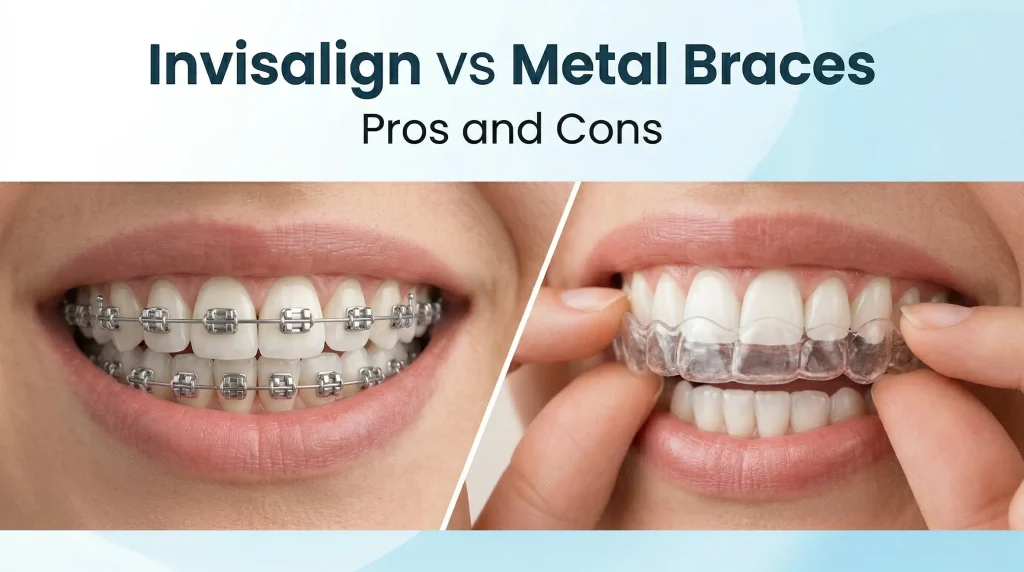
Deciding between Invisalign vs metal braces is a common step for patients planning orthodontic treatment. Both methods are designed to align teeth effectively, but they differ in how they function and the type of lifestyle they support. Invisalign treatment involves transparent, removable aligners that are discreet in appearance, while metal braces use fixed brackets and wires attached to the teeth.
The most suitable option depends on factors such as the complexity of your dental issue, your budget, and your daily routine. This guide explains the major differences, advantages, limitations, and cost considerations to help you make an informed decision in consultation with your orthodontist.
What is Invisalign?
Invisalign is a modern orthodontic system that uses a series of custom-made, removable clear aligners. Each set of aligners is worn for about one to two weeks, gradually moving teeth into position. The trays are made from smooth, BPA-free plastic — making them comfortable and nearly invisible when worn.
Because they are removable, you can eat, brush, and floss without any restrictions. Invisalign is popular among adults and teens who want a discreet treatment experience. Patients considering Invisalign treatment in Coimbatore often compare clear aligners with traditional braces to choose the most suitable option.
What are Metal Braces?
Metal braces are one of the most commonly used orthodontic solutions. They consist of small metal brackets bonded to each tooth, connected by an archwire. The wire is periodically tightened to gradually move teeth into the correct position.
Metal braces are fixed — meaning they stay on your teeth throughout the treatment period. They are highly effective for correcting a wide range of dental issues, including complex misalignments. Modern metal braces are smaller and more comfortable than older versions.
Invisalign vs Metal Braces – Key Differences
Appearance
Invisalign aligners are transparent and sit flush against your teeth. Most people won’t notice you’re wearing them. Metal braces are clearly visible — with brackets and wires on the front of your teeth.
For adults in professional or social settings, clear aligners vs metal braces appearance is often the deciding factor. Teens who don’t mind visible braces may find metal braces perfectly fine.
Comfort
Invisalign trays are made from smooth plastic with no sharp edges. Initial tightness when switching trays is normal but mild. Metal braces can cause mouth soreness, especially after adjustments. The brackets and wires may irritate the inner lips and cheeks.
Comfort with Invisalign vs braces is generally better — but both cause some discomfort during active tooth movement.
Treatment Duration
- Invisalign: 6 to 18 months on average (mild to moderate cases)
- Metal Braces: 18 to 36 months (all case types)
Treatment duration depends on the complexity of your case. Simple spacing or crowding issues respond quickly to both methods. Severe misalignments may require braces for longer duration. Invisalign effectiveness in less complex cases is comparable to braces in speed.
Effectiveness
Metal braces are more effective for complex dental corrections — severe crowding, large gaps, bite issues, and jaw problems. Invisalign works very well for mild to moderate cases. New generations of Invisalign technology now treat a wider range of conditions than before.
If your case is complex, your orthodontist may recommend braces for better control over tooth movement.
Maintenance
Invisalign:
- Remove before eating or drinking anything other than water
- Rinse aligners after removal
- Brush and floss normally
- Clean trays daily with a soft brush
Metal Braces:
- Avoid sticky, hard, or crunchy foods
- Use special floss threaders or interdental brushes
- Brush carefully around each bracket
- Attend regular adjustment appointments
Invisalign maintenance is generally more straightforward. Metal braces require more careful cleaning habits to avoid plaque buildup around brackets.
Cost Comparison
| Factor | Invisalign | Metal Braces |
| Average Cost | ₹80,000 – ₹2,50,000 | ₹25,000 – ₹80,000 |
| Insurance Coverage | Partial (varies) | Partial (varies) |
| Payment Plans | Available | Available |
| Retainers After Treatment | Required | Required |
The cost of Invisalign vs braces is a significant difference. Invisalign tends to cost more due to the technology involved. However, many clinics offer EMI options, making it accessible. Always confirm the full treatment cost — including retainers and follow-up visits — before deciding.
Comparison Table – Invisalign vs Metal Braces
| Feature | Invisalign | Metal Braces |
| Visibility | Nearly invisible | Clearly visible |
| Removable | Yes | No |
| Comfort | Smoother, less irritation | May cause soreness |
| Treatment Time | 6–18 months | 18–36 months |
| Effectiveness | Mild to moderate cases | All case complexities |
| Food Restrictions | None | Several |
| Cleaning Ease | Easy | Requires more effort |
| Cost | Higher | Lower |
| Best For | Adults, professionals, teens | Complex cases, younger patients |
Pros and Cons of Invisalign
Pros:
- Nearly invisible — no impact on appearance
- Removable for eating, brushing, and special events
- Smoother and more comfortable than metal brackets
- Fewer emergency visits for broken wires
- Easier oral hygiene routine
Cons:
- Higher cost compared to traditional braces
- Must be worn 20–22 hours daily for results
- Not ideal for severe or complex dental issues
- Aligners can be lost or misplaced
- Requires discipline to wear consistently
Pros and Cons of Metal Braces
Pros:
- Effective for all levels of dental complexity
- Lower cost — more accessible for many patients
- No compliance required — fixed in place
- Precise control over tooth and jaw movement
- Widely available at most orthodontic clinics
Cons:
- Visible on teeth — affects appearance
- Food restrictions (no sticky, hard foods)
- Can cause discomfort after adjustments
- More difficult to clean thoroughly
- Risk of white spots if oral hygiene is poor
Which Option is Better for You?
Selecting the right orthodontic treatment depends on factors such as your dental condition, lifestyle preferences, and treatment expectations. Each option offers unique advantages based on individual needs.
You may consider Invisalign if:
- You prefer a treatment option that is subtle and not easily noticeable
- You are a professional or adult seeking a more discreet solution
- Your alignment concern is mild to moderate
- You are able to wear the aligners consistently for 20–22 hours each day
You may consider Metal Braces if:
- Your dental alignment issue is more complex
- Cost plays an important role in your decision
- You prefer a fixed solution that does not require daily removal
- You are a younger patient who may find removable aligners difficult to manage regularly
It is always recommended to consult an experienced orthodontist before making a final decision. A proper clinical examination, along with necessary scans or X-rays, helps determine the most suitable treatment for achieving effective results.
Conclusion
Both Invisalign and metal braces are effective and well-established treatments for achieving properly aligned teeth. The right choice depends on factors such as your lifestyle preferences, budget, and the complexity of your dental condition. If you value a more discreet and comfortable option, Invisalign may be suitable. If you require more extensive correction at a comparatively lower cost, metal braces remain a dependable solution.
The most important step is to consult an experienced orthodontist who can evaluate your teeth and recommend the most appropriate treatment plan for your specific needs. If you are looking for orthodontic treatment, DCP Dental Clinic in Coimbatore provides professional Invisalign and metal braces services with personalized care to help you achieve a confident and healthy smile.
FAQs About Invisalign vs Metal Braces
1. Is Invisalign more effective than metal braces? For mild to moderate cases, Invisalign delivers results comparable to metal braces. However, for severe crowding, bite issues, or complex corrections, metal braces offer more precise control. Your orthodontist will recommend the best option after examining your teeth.
2. How long does Invisalign treatment take compared to braces? Invisalign treatment typically takes 6 to 18 months for suitable cases. Metal braces generally require 18 to 36 months. Treatment duration varies based on the complexity of your dental condition and how consistently you wear your aligners.
3. Is Invisalign more expensive than traditional braces? Yes, Invisalign usually costs more than metal braces. The cost of Invisalign vs braces can differ significantly depending on the clinic, case complexity, and city. Many dental clinics offer flexible payment options to make the treatment more affordable.
4. Can I eat normally with Invisalign? Yes. One of the key benefits of Invisalign is that you remove the aligners before eating. This means no food restrictions. With metal braces, you need to avoid sticky, hard, or crunchy foods throughout your treatment.
5. Are clear aligners as strong as metal braces? Clear aligners work well for most mild to moderate orthodontic cases and are quite durable. Metal braces provide stronger mechanical force — making them better suited for complex tooth movements. Both are proven orthodontic treatments when used for the right cases.