

You’ve been thinking about Invisalign — but somewhere between that first thought and before booking a consultation, the doubts keeps in.
Does it actually work for serious cases? Will it hurt? Is it worth the money?
These are real questions. And a lot of what people “know” about Invisalign simply isn’t true – outdated information, social media noise, and word-of-mouth myths are stopping people from exploring a treatment that could genuinely change their smile.
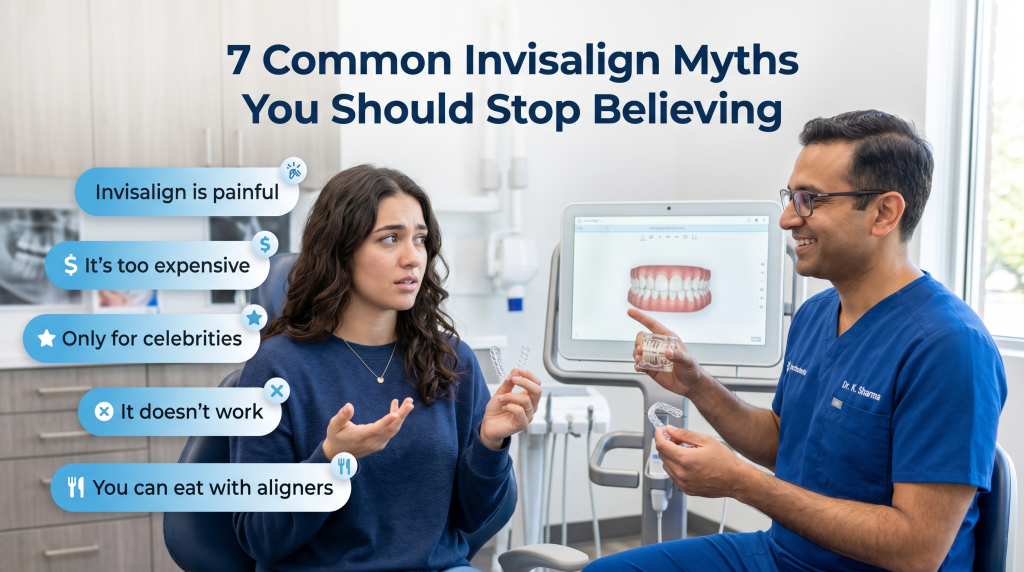
Let’s see the most common Invisalign myths patients ask about before starting treatment.
7 Common Invisalign Myths You Should Stop Believing
Myth #1: Invisalign Only Works for Minor Cases
Why people believe this: Early versions of clear aligners were genuinely limited. They could handle spacing and mild crowding — but not much else. That reputation stuck.
The Truth
Today’s Invisalign technology is a completely different story. With advanced 3D treatment planning and features like SmartTrack material and precision attachments, Invisalign can now treat a wide range of orthodontic issues — including moderate to severe crowding, overbites, underbites, crossbites, and significant gaps.
Can Invisalign fix crooked teeth that are more complex? In many cases, yes. Your orthodontist will assess your specific situation, but dismissing Invisalign as “only for simple cases” is simply outdated thinking.
Myth #2: Invisalign Hurts a Lot
Why people believe this: Braces are associated with soreness, tightening appointments, and the occasional wire poking your cheek. People assume clear aligners must be equally painful.
The Truth
Does Invisalign hurt? You might notice mild pressure when starting a new aligner tray, especially during the first couple of days, but it usually settles quickly. That’s your teeth actually moving, which means it’s working.
But “pressure” and “pain” are different things. Most patients describe the discomfort as mild and short-lived. There are no metal brackets, no sharp edges, and no adjustment appointments where someone cranks a wire. For most people, Invisalign vs braces comes down to a clear winner in the comfort department.
Myth #3: Invisalign Is Only for Adults
Why people believe this: Most Invisalign marketing historically featured adults. Teenagers assumed it wasn’t for them.
The Truth
Invisalign offers a specific product line called Invisalign Teen, designed with younger patients in mind — including compliance indicators and extra aligners for the inevitable losses. Teens are actually excellent candidates for clear aligner treatment, often more motivated by the discreet appearance than adults are.
The key factor isn’t age — it’s whether the patient’s teeth and jaw have developed enough for orthodontic treatment. Your orthodontist can make that call at a consultation.
Myth #4: Invisalign Is Too Expensive
Why people believe this: Clear aligners are associated with premium dental work, and the upfront number can look intimidating.
The Truth
Invisalign facts on cost are more nuanced than most people expect. In many cases, Invisalign is priced comparably to traditional braces — sometimes even similarly when you factor in fewer in-office visits and no emergency wire appointments.
Many dental practices offer flexible payment plans, and some dental insurance plans now cover Invisalign the same way they cover braces. Before writing it off as unaffordable, it’s worth getting an actual quote from your dentist or orthodontist. The number might surprise you.
Myth #5: You Can Eat While Wearing Your Aligners
Why people believe this: Because the aligners are removable, some people assume they’re optional during meals too.
The Truth
This one’s actually the opposite of a myth — it’s a dangerous misunderstanding. Aligners should be taken out before eating or drinking anything besides plain water..
Eating with aligners can warp the plastic, trap food particles against your teeth, and stain the trays. This is actually one of the real advantages of Invisalign: you can eat whatever you want — you just do it without the aligners in. Pop them back in after you’ve eaten and brushed, and you’re good to go.
Myth #6: Invisalign Takes Much Longer Than Braces
Why people believe this: The idea that something “removable” must be less effective leads people to assume it’s also slower.
The Truth
Treatment time depends far more on the complexity of your case than on the type of appliance. For many straightforward cases, Invisalign treatment can actually be faster than traditional braces — some patients complete smile correction in as little as six months.
Average treatment time for clear aligners is roughly 12 to 18 months, which is comparable to braces for similar cases. Wearing your aligners for the recommended 20 to 22 hours per day is what keeps treatment on track.
Myth #7: Invisalign Is Completely Invisible
Why people believe this: The name. And the marketing.
The Truth
“Virtually invisible” is more accurate than “completely invisible.” Up close, in certain lighting, someone paying close attention may notice you’re wearing aligners. They’re clear — not magic.
That said, for most everyday situations — work meetings, social events, photographs — the aligners are far less noticeable than metal brackets and wires. This is genuinely one of the biggest advantages of Invisalign, especially for adults and teens who feel self-conscious about orthodontic treatment. Just don’t expect them to be literally invisible, because that’s setting yourself up for unnecessary disappointment.
Questions to Ask Before Starting Treatment
Walking into your first orthodontic consultation prepared makes a real difference. Here are the questions worth asking:
- Am I a good candidate? Be specific about your concerns — gaps, crowding, bite issues.
- How long will my treatment take? Ask for a realistic range based on your actual case.
- What happens if I lose an aligner? Good practices have a clear protocol for this.
- How often will I need check-in appointments? Invisalign requires fewer visits than braces, but they’re still important.
- What does the cost include? Retainers, refinements, and follow-up care should all be factored in.
Conclusion
The common Invisalign myths that circulate online aren’t just annoying — they’re genuinely stopping people from taking a step that could improve both their smile and their long-term dental health.
Ready to straighten your teeth without metal braces? Book a consultation at DCP Dental Clinic and discover personalized options for Invisalign treatment in Coimbatore designed around your smile goals and lifestyle.
Your smile is worth the conversation.
FAQs
Q1: Does Invisalign hurt more than braces?
Invisalign typically causes less discomfort than traditional braces. Most patients experience mild pressure when switching to a new set of aligners, but there are no metal wires or brackets to cause irritation.
Q2: Can Invisalign fix severely crooked teeth?
Yes, in many cases. Modern Invisalign technology can treat moderate to severe crowding, bite issues, and spacing problems. A consultation with an orthodontist will confirm whether it’s suitable for your specific case.
Q3: How long does Invisalign treatment take?
Most patients complete Invisalign treatment in 12 to 18 months, depending on case complexity. Simpler cases can sometimes be resolved in as little as six months.
Q4: Is Invisalign more expensive than braces?
Not necessarily. Invisalign is often priced comparably to traditional braces, and many dental insurance plans cover it similarly. Payment plans are widely available.
Q5: Can teenagers use Invisalign?
Yes. Invisalign Teen is specifically designed for younger patients and includes features like compliance indicators and replacement aligners. Age is less important than jaw development.